![[EN] MUDr. Pavel Vachulka](https://zubnipececb.cz/en/wp-content/uploads/2026/03/Logo.svg)


Article content
→ When is a dental implant inserted? → When a tooth is lost due to tooth decay or inflammation → After an injury or accident → In cases of congenital dental agenesis → When several adjacent teeth fall out → In the case of toothlessness – when all teeth are missing → Why a dental implant makes sense → The implant also helps psychologically. → When is a dental implant not yet suitable? → Summary: When is a dental implant a good idea?Dental implants are among the most reliable methods available today for replacing a missing tooth or an entire set of teeth. They allow you to fully restore not only the aesthetics of your smile but also your chewing function.
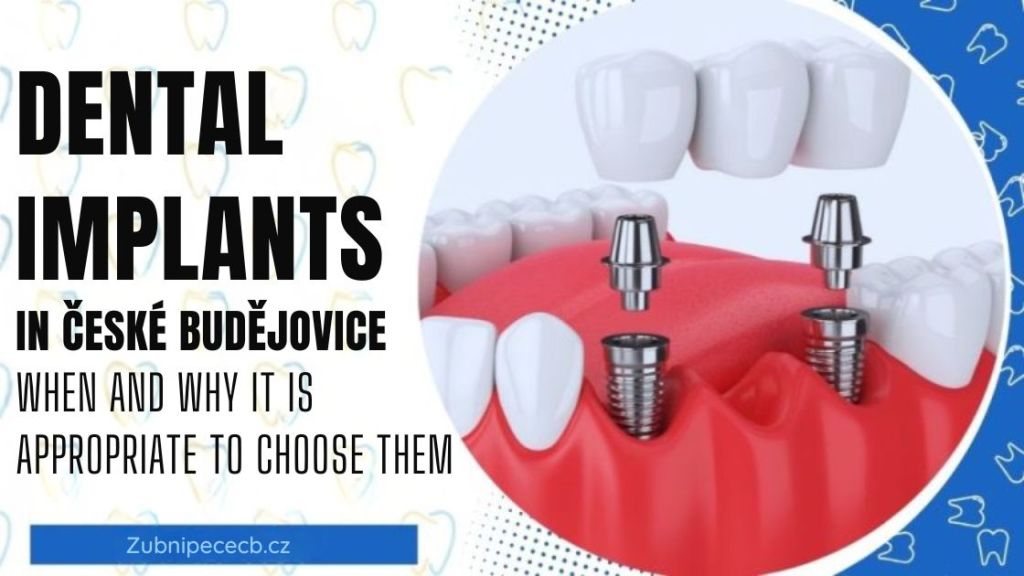
An implant functions like an artificial tooth root that is firmly anchored in the jawbone. A crown or bridge is then attached to it – the result looks and feels natural and, with proper care, can last a lifetime.
When is a dental implant inserted?
When a tooth is lost due to tooth decay or inflammation
Tooth decay, a crack, or repeated inflammation of the dental nerve can damage a tooth so severely that it cannot be saved. If a tooth has to be extracted, a gap is created.
In such cases, an implant is the ideal solution: it behaves like a natural tooth, requires no intervention on adjacent teeth, and helps preserve the jawbone.
After an injury or accident
An injury can lead to a broken or completely lost tooth. Whether it’s a sports accident or a fall, an implant can reliably replace the tooth.
The advantage: The natural appearance and function of the teeth are preserved – the patient can speak, eat, and smile without restrictions again.
In cases of congenital dental agenesis
Some people have teeth that never develop. This condition is called agenesis and is often treated with an implant.
The implant replaces a tooth that never grew and blends aesthetically into the dentition, so that it looks natural and harmonious.
When several adjacent teeth fall out
If two or three adjacent teeth are missing, this can be remedied with implants, between which a bridge is attached. Unlike a conventional bridge, the surrounding healthy teeth do not need to be ground down.
This solution is stable, aesthetically pleasing, and long-lasting.
In the case of toothlessness – when all teeth are missing
Dental implants are not only suitable for single teeth. Patients who have lost all their teeth can replace their entire dentition with multiple implants to which a fixed prosthesis is attached.
This system, known as All-on-4, All-on-6, or All-on-X , offers significantly greater comfort and stability compared to traditional removable dentures, which can slip or shift.
Why a dental implant makes sense
The loss of a tooth doesn’t just mean an empty space in your teeth. Within a few months after extraction, bone loss occurs in the jaw because the toothless area is no longer under stress.
A dental implant stops this process – it transmits chewing forces like a natural tooth root, thus keeping the jawbone healthy and strong. This preserves the jaw shape and the stability of the entire oral cavity in a natural way.
The implant also helps psychologically.
Many patients report a loss of self-confidence after losing a tooth. They are afraid to laugh and have difficulty eating or speaking.
An implant eliminates these problems – it functions and looks just like a natural tooth. This allows you to speak, eat, and laugh without restrictions again.
When is a dental implant not yet suitable?
Before an implant can be placed, the jawbone must be in good condition and the gums healthy.
Implantation is usually postponed in the following cases:
- acute inflammation in the mouth,
- untreated periodontitis
- or in the case of significant bone loss (in these cases the bone can be replenished).
Sometimes it is necessary to first treat the surrounding teeth or build up bone volume so that the implant is sufficiently anchored.
Summary: When is a dental implant a good idea?
A dental implant is suitable in any situation where one or more teeth are missing – whether after a tooth extraction, an injury, or due to congenital dental malformation. It contributes to maintaining jaw health, an aesthetically pleasing smile, and proper dental function.
If you are considering dental implants in České Budějovice or the surrounding area, contact us.
Dr. Vachulka will assess your condition and propose an individual solution that optimally meets your needs and possibilities.
Need advice about your smile?
Book a consultation with MUDr. Vachulka and get a personalized professional recommendation.
Book Now